

One of the first questions almost everyone asks when buying an engagement ring is:
“How much am I supposed to spend?”
And usually, that question comes with a lot more underneath it.
Am I spending too much?
Not enough?
What’s normal?
What if I regret it?
What if she expects more?
What if I get taken advantage of?
There’s a huge amount of pressure attached to engagement ring budgets.
Pressure from:
Family
Friends
Social media
Online opinions
Cultural expectations
The jewellery industry itself
And unfortunately, a lot of engagement ring advice is built around selling, simplifying, or going viral. Not helping people make better decisions.
Because there's no universal “right amount” to spend on an engagement ring.
Not every relationship is the same.
Not every financial situation is the same.
Not every priority is the same.
And trying to force everyone into the same budget rule usually leads to bad decisions.
How much should you spend on an engagement ring?
You should spend an amount that feels financially comfortable while still aligning with your priorities, goals, and expectations for the ring.
There is no universal “correct” budget.
The best engagement ring budget is one that allows you to buy confidently without financial pressure, regret, or unnecessary compromises.
The “Three Months Salary” Rule Needs To Go
Let’s address the biggest one first.
The old “three months salary” rule is not a real financial guideline.
It was marketing.
And yet people still walk into consultations asking me if that’s what they’re supposed to spend.
It’s not.
Basing one of the most emotional purchases of your life on an outdated advertising slogan makes very little sense once you actually step back and think about it.
Because spending should never be determined by a generic formula.
It should be determined by:
your financial comfort
your priorities
your lifestyle
your long term goals
what matters most to you visually and emotionally
For some people, spending $10,000 feels completely comfortable.
For others, spending $30,000 feels completely reasonable.
Neither is automatically right or wrong.
What matters is whether the decision feels intentional and sustainable for you.
Is the three months salary rule for engagement rings real?
No.
The “three months salary” rule was created through jewellery marketing, not financial planning.
The right engagement ring budget depends on your financial comfort, priorities, and long term goals, not an outdated spending formula.
Why This Decision Feels So Emotionally Heavy
An engagement ring is not just another purchase.
An engagement ring becomes emotionally loaded very quickly because people treat it like a reflection of love, success, taste, and financial capability all at once.
And that meaning creates pressure.
I can’t count how many times clients have asked me:
“Is this enough?”
“Am I supposed to spend more?”
“How much do people normally spend?”
“What if she expects something bigger?”
A lot of buyers are quietly trying to solve for emotional approval.
Approval from:
Society
Their partner
Their family
Their peers
The internet
That’s usually the moment people stop making decisions for themselves and start making them for an imaginary audience.
And comparison is one of the fastest ways to lose confidence in this process.
Why do engagement ring budgets feel so stressful?
Engagement ring budgets feel stressful because you’re balancing emotional expectations, financial responsibility, and fear of regret all at the same time.
Most people aren’t just asking what they can spend.
They’re asking what they SHOULD spend.
The Biggest Mistakes People Make When Setting a Budget
This is where I see people get into trouble most often because they’re trying to navigate a very emotional decision without understanding how engagement ring pricing actually works.
Spending Based on Arbitrary Rules
This is probably the most common one.
People choose a budget because:
Someone online said they should
A friend spent a certain amount
A family member expects it
They think there’s a “normal” number they need to hit.
Most people don’t actually start with their own priorities.
They start with someone else’s expectations.
That’s usually where bad financial decisions begin.
So instead of building a budget around what makes sense for them, they build it around external pressure.
That leads to one of two things:
Overspending.
Or making compromises they regret later just to stay under a specific number.
Neither is a good outcome.
Trying to Impress People Instead of Prioritizing What Matters
I’ve seen people increase diamond grades simply so they could say they spent more money.
For example:
Moving from a VS1 to a VVS1 clarity.
Jumping into colourless grades.
Chasing “perfect” certificates.
Meanwhile, the diamond looks almost identical to the original option they were considering.
The extra cost often exists more on paper than visually.
That’s one of the biggest misconceptions in the industry.
More expensive doesn’t automatically mean more beautiful.
Sometimes it just means rarer specifications with very little visible difference.
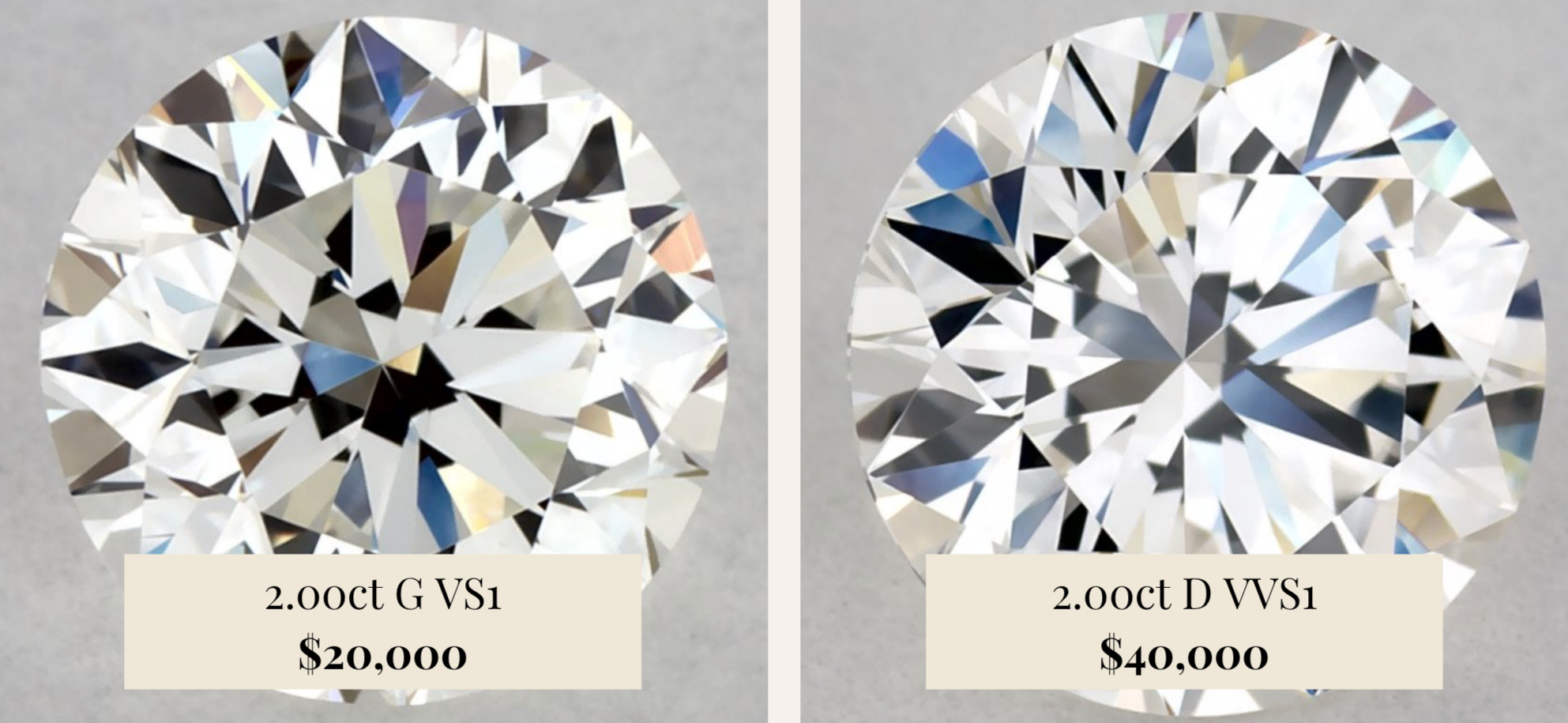
Some upgrades increase price far more than visible beauty.
Focusing Too Heavily on Resale Value
This is something I strongly caution people against.
An engagement ring shouldn’t be approached like an investment portfolio.
Even natural diamonds lose a significant amount of value after purchase, similar to buying a car.
And lab grown diamonds currently have little to no resale value at all.
That doesn’t mean they’re bad choices.
It just means resale shouldn’t be the primary factor driving your decision.
You also don’t want to begin a proposal or marriage focused on what happens if it ends.
Some people do eventually upgrade or trade in their ring later, and that’s completely fine.
But future resale potential should not be the thing determining how much you spend today.
Compromising Aggressively to Stay Under a Certain Number
And this is the other side of the problem.
I’ve seen people become so afraid of overspending that they compromise themselves into a ring they don’t actually feel good about.
Especially when trying to hit unrealistic expectations for a lower budget.
Here’s an example:
You want a large natural diamond, but refuse to go above a certain number.
So you sacrifice:
Cut quality
Visual performance
Ring durability
Craftsmanship
Structural integrity
And now, you end up with:
A ring that doesn’t look good
Constant repair issues
And regret every time you look at it
Ironically, trying too hard to save money can sometimes cost more in the long run.
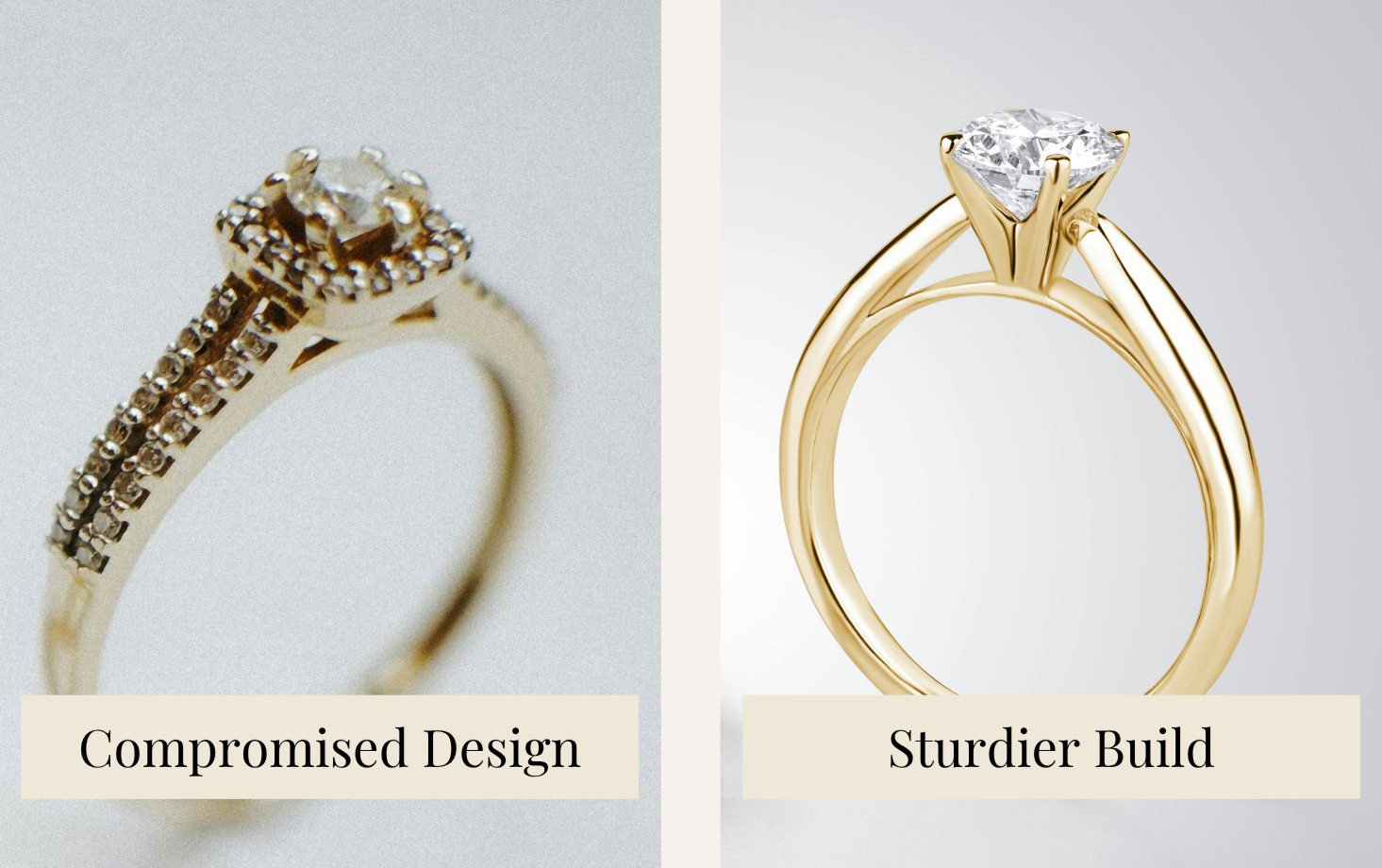
Cutting costs in the wrong places often creates expensive problems later.
What Actually Affects Engagement Ring Price?
This is one of the biggest areas of confusion for buyers.
People often assume price is mostly about size.
It’s not.
There are many things that affect the cost of an engagement ring, including:
Carat weight
Colour
Clarity
Natural vs lab grown
Ring craftsmanship
Metal type
Brand markup
Customization
Canadian origin premiums
And not all price increases create meaningful differences.
Carat Weight Jumps Can Dramatically Increase Price
This is especially true with natural diamonds.
There are major pricing jumps at “magic sizes” like: 1.00ct, 1.50ct, 2.00ct, 3.00ct…
Sometimes staying slightly under those thresholds makes sense financially.
But that advice is often oversimplified online.
For lab grown diamonds, those jumps are usually far less dramatic.
So blindly applying the same “rules” doesn’t always make sense.
Some Upgrades Are Mostly Paying For Paper
This is where the industry quietly makes a lot of money from fear and perfectionism.
For brilliant cut diamonds, I rarely recommend going above VVS2 clarity.
Most people can comfortably stay in the VS range and still have an eye clean diamond.
Similarly, I often recommend staying near the top of the near-colourless range instead of paying huge premiums for DEF colour grades.
That doesn’t mean higher grades are “bad.”
It means many buyers are paying significantly more for differences they’ll never actually see.
Some Things ARE Worth Spending More On
There are absolutely areas where spending more makes sense.
For diamonds, cut quality and overall beauty matter enormously.
For rings, craftsmanship and durability are king.
An engagement ring is supposed to last a lifetime.
Poor construction usually reveals itself eventually through:
Bent bands
Loose stones
Constant repairs
Premature wear
You truly do get what you pay for with jewellery.
Most people don’t overspend because they’re irresponsible.
They overspend because they don’t yet know which details genuinely matter and which ones are mostly marketing.
Why Confidence Matters More Than the Number Itself
The people who feel best about their purchase are usually not the ones who spent the most money.
They’re the ones who:
Understand their priorities
Understand their tradeoffs
Understand what their budget realistically gets them
That creates confidence.
Once people finally understand what they’re looking at, the panic disappears almost immediately.
It becomes less about:
Fear
Pressure
Second guessing
Trying to avoid getting ripped off
And more about:
Excitement
Meaning
Planning the proposal
Feeling good about the decision
That emotional shift matters a lot more than people realize.
What’s the best engagement ring budget?
The best engagement ring budget is one that feels financially responsible while still allowing you to buy something you genuinely feel proud and confident giving.
A higher budget doesn’t automatically create a better decision.
Clarity and confidence do.
The Goal Isn’t Spending More Or Less
This is important.
My role is never to push someone toward the highest possible number.
In fact, I often recommend the opposite.
Sometimes the smartest decision is:
Going slightly smaller
Avoiding unnecessary upgrades
Prioritizing durability over trendiness
Choosing a better cut over a bigger size
Skipping expensive custom work that adds little real value
The goal is not maximizing spend.
The goal is helping someone feel genuinely excited about the ring they chose, not trapped wondering if they made the wrong decision.
The best engagement rings are rarely the ones that cost the most.
They’re the ones where the buyer understood exactly what they were paying for.
You Don’t Need To Figure This Out Alone
One of the biggest mistakes people make is assuming they should somehow instinctively understand all of this.
Most people buy an engagement ring once.
Of course it feels overwhelming.
Especially when there’s:
Pressure
Misinformation
Conflicting advice
Most buyers aren’t underprepared.
They’re under supported.
It’s lack of clarity around what actually matters for your situation.
That’s why independent guidance changes everything.
Because sometimes the most valuable thing isn’t finding the cheapest ring or the biggest diamond.
It’s having someone help you understand what makes sense before you spend tens of thousands of dollars.
Before You Set Your Budget, Understand Your Priorities
If you’re currently trying to figure out what makes sense for your engagement ring budget, start with your priorities first. Not arbitrary rules or outside pressure.
Because the right budget isn’t about impressing other people.
It’s about making a confident decision you’ll feel good about long after the proposal.
If you want expert guidance navigating diamond quality, budgeting, tradeoffs, or ring design decisions, explore Engagement Ring Guidance or request a private consultation.
Still not sure what actually makes sense for you?
Forget the “three months salary” rule. Answer 6 quick questions and get a realistic starting range based on your actual priorities, not a marketing slogan.
Helpful Next Steps
Buying an Engagement Ring Without Independent Advice is a Risk
Buying an Engagement Ring Online? Read This First
Is This a Good Diamond? How to Actually Tell
About the Author
Robyn Bell-Wong is a Calgary-based Independent Jewellery Advisor and Consultant specializing in engagement rings, diamonds, and meaningful fine jewellery purchases.
With over 20 years of experience in service, 5 years at the top of a fine jewellery house, 300+ clients guided, and a GIA Applied Jewelry Professional designation, she provides private, buyer-side guidance to clients making high value jewellery decisions across Canada and the U.S.
Unlike traditional jewellery retail environments, Robyn does not sell jewellery or work on commission. Her role is to act solely in her client’s best interest. Offering clear, objective guidance on quality, value, and design so clients can make confident, well-informed decisions.
Through Refined by Robyn, she supports clients with engagement ring guidance, independent ring reviews, and private jewellery consulting for meaningful purchases.
Her work focuses on helping clients avoid costly mistakes, navigate overwhelming options, and choose jewellery that truly reflects their intention, style, and budget.
Request a private consultation
Follow on Instagram @refined.by.robyn