
Most people start researching engagement rings for the same reason:
You want to feel confident before investing a significant amount of money.
That makes sense.
You don’t want to overpay.
You don’t want to get ripped off.
You don’t want to accidentally buy something low quality.
You don’t want to regret the decision later.
So you do what everyone tells you to do.
You research.
Get quotes.
Watch videos.
Learn the 4Cs.
Watch TikTok’s.
Read blog posts.
Browse Instagram.
Read Reddit threads.
Save Pinterest photos.
Compare diamonds online.
Learn ratios, angles, proportions, grading…
And at first, it feels empowering.
Like you’re becoming an informed buyer.
But then something happens.
Instead of becoming more confident…
You become more overwhelmed.
More uncertain.
More skeptical.
More anxious.
More stuck.
And eventually, a lot of people hit the same point:
“I honestly don’t even know what I’m supposed to do anymore.”
That’s not an accident.
Why does researching engagement rings feel so overwhelming?
Because most engagement ring research gives you information without helping you interpret what actually matters for your specific situation.
The result is often:
information overload
conflicting advice
decision paralysis
and emotional exhaustion
The Engagement Ring Industry Was Built Around Consumer Psychology
This is the part a lot of people don’t realize.
The “traditional” engagement ring buying process didn’t happen naturally.
It was built.
Over decades…
Through marketing.
Sales psychology.
Luxury positioning.
Emotional sales training.
Consumer behaviour research.
The jewellery industry understands something extremely well:
People buying engagement rings are emotionally invested in getting this decision right.
Not weak. Not naive.
Just emotionally invested.
And when someone is emotionally invested, they become highly motivated to “Get it right.”
That emotional pressure drives behaviour.
Research behaviour.
Spending behaviour.
Comparison behaviour.
Decision behaviour.
The traditional engagement ring process was designed around that psychology long before you ever started shopping.
And most people walk into it without realizing they’re following a path that was laid out for them decades ago.
Online Research Creates The Illusion Of Control
This is one of the biggest traps I see in modern engagement ring shopping.
You think more research will eventually eliminate uncertainty.
So you keep researching.
Because researching feels productive.
It feels responsible.
It feels protective.
Like if you just learn enough, you’ll avoid making a mistake.
But engagement rings are different.
You can’t approach this the same way you buy a TV, laptop, or camera.
Because diamonds and jewellery are significantly more nuanced than their specs alone.
The Internet Teaches You How To Compare Specs. Not How To Evaluate Jewellery.
This is an extremely important distinction.
Most online jewellery education focuses on:
Certificates
Proportions
Ratios and angles
Price comparisons
And you believe that if you learn enough technical information, you’ll eventually find the “perfect” diamond yourself.
But diamonds aren’t spreadsheets.
And a grading report doesn’t tell you exactly how a diamond will look in real life.
It tells you:
Measurements
The grading ranges
Technical information
That’s it.
Two diamonds with nearly identical specs can look completely different in person.
And no amount of memorized percentages changes that reality.
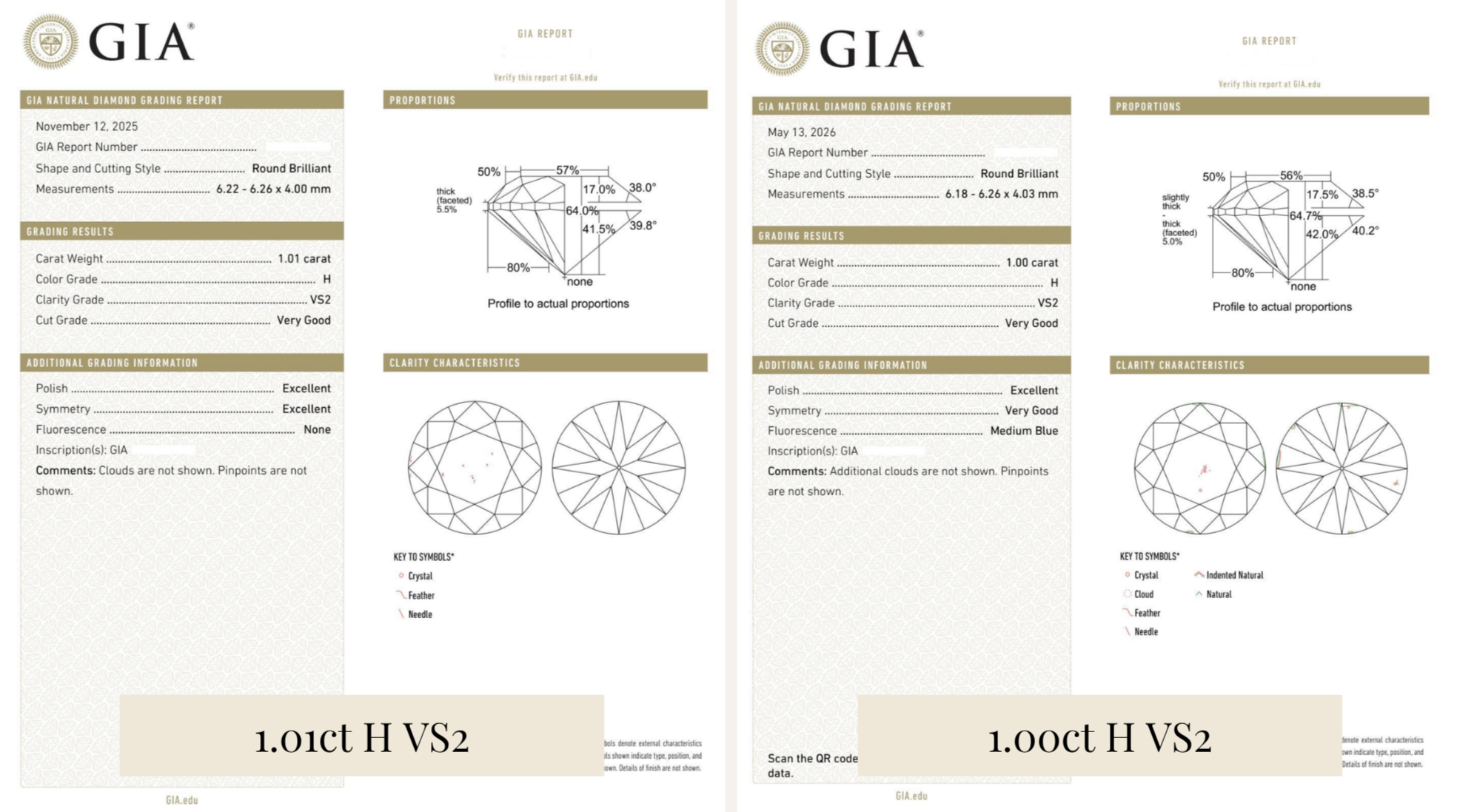
Similar specs do not guarantee similar beauty or performance.
“Good Deal” And “Good Ring” Are Not The Same Thing
This is another place people get trapped… a lot.
A huge amount of online research revolves around finding the best price.
I get it. This is a major purchase. You want to protect yourself financially.
But somewhere along the way, buyers start confusing:
“Lowest price”
with
“Best decision.”
Those are not the same thing.
A ring can be:
Cheap
Mass produced
Poorly constructed
Visually disappointing
Constantly needing repairs
… while still technically being a “good deal.”
That’s the problem.
Because most buyers don’t actually know how to evaluate:
Craftsmanship
Structural integrity
Long term durability
Real visual performance
Or hidden compromises
So you default to what feels measurable:
Price, specs, discounts, and certificates.
That creates a dangerous false sense of confidence.
The Industry Quietly Normalized A Lot Of Bad Advice
There are several narratives in the industry that became so normalized people rarely stop to question them anymore.
“Bigger automatically means better.”
“Financing is normal.”
“You should stretch your budget.”
“An engagement ring is an investment.”
“Just get a custom ring.”
And a lot of this exists because it helps increase sales.
That’s the uncomfortable reality.
The famous “three month’s salary” rule worked for decades because it successfully normalized overspending through emotional pressure.
And versions of that same psychology still exist everywhere today.
Sometimes much more subtly.
The “Custom Ring” Narrative Is Especially Misleading
This one frustrates me constantly.
A lot of stores market rings as “custom” when what they really mean is:
“Choose a diamond and choose a setting.”
That is not the same thing as a fully custom designed and manufactured ring.
But buyers don’t know that because the industry rarely explains the difference clearly.
Why?
Because “custom” sounds more luxurious.
More emotional.
More valuable.
And luxury marketing understands emotional perception extremely well.
More Research Creates Decision Paralysis
This is the stage where people usually contact me.
Not at the beginning.
At the breaking point.
After months of researching.
After dozens of tabs.
Videos.
Quotes.
Reddit threads.
Instagram saves.
Online comparisons.
And instead of confidence, they feel:
Stressed
Skeptical
Exhausted
Unable to decide
Terrified of making the wrong choice
Some people become so overwhelmed they stop caring about the proposal entirely.
Others become hyper fixated on tiny details that barely matter visually.
And some become convinced they know enough to outsmart the industry entirely.
Ironically, that overconfidence can be just as dangerous as knowing nothing.
Especially when someone starts believing:
“If the specs are right, the diamond must be good.”
That simply isn’t how jewellery works.
Why do people struggle to decide on an engagement ring?
Most people struggle to decide on an engagement ring because they’re trying to create certainty through information alone.
Confidence in jewellery buying comes from interpretation, context, guidance, and trust. Not endless comparison.
Buyers Think They’re Supposed To Do This Alone
This is probably the most damaging industry narrative of all.
That somehow you should already know how to navigate:
Pricing
Markups
Tradeoffs
Durability
Sales tactics
Craftsmanship
Diamond quality
And emotional pressure
… despite never doing this before.
Think about how strange that actually is.
People hire:
Lawyers for contracts
Realtors for homes
Financial advisors for investments
But somehow it became normalized that the person SELLING you the ring should also be the only person advising you on what to buy.
That makes no sense.
Especially in an industry with:
Massive markups
Emotional sales pressure
And extremely uneven transparency
This Is Exactly Why I’m Here
I started in jewellery sales.
I know the scripts.
The training.
The psychology.
The process.
And I was good at it.

But over time, I became increasingly uncomfortable watching how often people were sold:
Emotion instead of quality
Status instead of suitability
Marketing instead of clarity
I saw rings sold under false pretences.
Weak construction presented as luxury.
People pushed to spend more emotionally.
Buyers manipulated through lack of knowledge.
Not always maliciously.
But structurally.
Because that’s how the traditional system is designed to function.
And the longer I looked, the more obvious it became:
There was no one truly sitting on the buyer’s side of the table.
That’s why I’m here.
Not to sell you a ring.
Not to push inventory.
Not to maximize commission.
But to help you:
Avoid costly mistakes
Understand what actually matters
And feel genuinely confident in your decision
Sometimes that means recommending spending less.
Sometimes it means structural changes.
Sometimes I say: “Don’t buy this.”
That level of honesty is disruptive in an industry built around selling.
And yes, some people in the industry dislike that.
But the jewellers who value transparency and conscious selling?
They usually understand exactly why my work matters.
Because I’m not anti-jeweller.
I’m pro-buyer.
You Don’t Need More Information. You Need Interpretation
This is the realization most people eventually come to.
The issue isn’t lack of effort.
It’s that you’re trying to solve an emotionally nuanced luxury purchase through endless information gathering.
At some point, more information stops creating certainty, and starts creating noise.
That’s where guidance changes everything.
Because real confidence doesn’t come from:
Memorizing specs
Reading another reddit thread
Comparing twenty more diamonds online
It comes from finally having someone help you understand:
what matters
what doesn’t
what tradeoffs are worth it
what’s actually right for YOU
You Don’t Have To Do This Alone
If researching engagement rings has left you feeling more stressed and overwhelmed, that’s understandable.
You’re trying to navigate an industry built around emotional pressure, technical complexity, and consumer psychology without expert interpretation.
Of course it’s exhausting.
That’s exactly why I built this business.
So you would finally have someone on your side.
Without sales pressure.
Without commission.
Without hidden incentives.
Just honest guidance designed to help you make the right decision confidently.
If you want expert support evaluating diamonds, understanding tradeoffs, avoiding regret, and navigating this process with confidence, explore Engagement Ring Guidance or request a private pre-consult call.
Because you were never supposed to figure all this out alone.

Ready for one clear answer instead of twenty more tabs?
Skip the Reddit threads and conflicting videos. Answer 6 quick questions and get a straight answer on shape, style, and budget, no sales call, no pressure.
About the Author
Robyn Bell-Wong is a Calgary-based Independent Jewellery Advisor and Consultant specializing in engagement rings, diamonds, and meaningful fine jewellery purchases.
With over 20 years of experience in service, 5 years at the top of a fine jewellery house, 300+ clients guided, and a GIA Applied Jewelry Professional designation, she provides private, buyer-side guidance to clients making high value jewellery decisions across Canada and the U.S.
Unlike traditional jewellery retail environments, Robyn does not sell jewellery or work on commission. Her role is to act solely in her client’s best interest. Offering clear, objective guidance on quality, value, and design so clients can make confident, well-informed decisions.
Through Refined by Robyn, she supports clients with engagement ring guidance, independent ring reviews, and private jewellery consulting for meaningful purchases.
Her work focuses on helping clients avoid costly mistakes, navigate overwhelming options, and choose jewellery that truly reflects their intention, style, and budget.
Request a private consultation
Follow on Instagram @refined.by.robyn