
Round diamonds are the most popular diamond shape in the world.
And because of that, they’re also the most written about.
Which means if you’ve been researching, you’ve probably already read about:
The 4Cs.
Depth ratios.
Crown angles.
Table percentages.
Triple Excellent grades.
And yet somehow, after all of that, a lot of buyers still end up with a diamond that doesn’t look the way they expected.
Not because they didn’t research enough.
But because most of what’s written about round diamonds online focuses on the wrong things.
So here’s what actually matters.
What should I look for in a round diamond?
The most important things to look for in a round diamond are light performance, clarity placement, and fluorescence.
Triple Excellent grades and strong proportions matter, but they don’t guarantee a beautiful diamond.
What you actually see when you look at the stone matters more than what’s on the certificate.
Why Round Diamonds Feel Like the “Safe” Choice
There’s a common assumption that round diamonds are easier to buy than other shapes.
More forgiving.
More standardized.
More predictable.
And in some ways, that’s true.
Round brilliant diamonds are cut to a more defined standard than fancy shapes like ovals or emeralds.
But that standardization creates its own problem.
It makes buyers feel like if the specs look right, the diamond must also be right.
And that’s where things can go wrong.
Because two round diamonds with nearly identical certificates can look completely different in real life.
And the differences that matter most aren’t always the ones getting the most attention online.
1. Light Performance (And What “Sparkle” Actually Means)
This is the most important thing.
And it’s also the thing most easily misunderstood.
When I’m reviewing a round diamond, the first thing I look at is performance under light.
Not the certificate.
The video.
Specifically, I want to see:
Brilliance - the bright white light returning from inside the diamond
Fire - the coloured flashes of light that appear with movement
Contrast - the crisp play of light and dark across the facets that gives a diamond depth and dimension
When all three are working together, the diamond looks alive.
It doesn’t just reflect light. It throws it.
And here’s the practical test I use:
In a 360° video under ideal lighting, a well performing round diamond should look almost blindingly sparkly.
If it looks slightly dull or flat even in that environment (which is the most flattering possible lighting scenario) it’s going to look significantly more dull in real life.
That gap between ideal lighting and everyday lighting is where performance really shows.
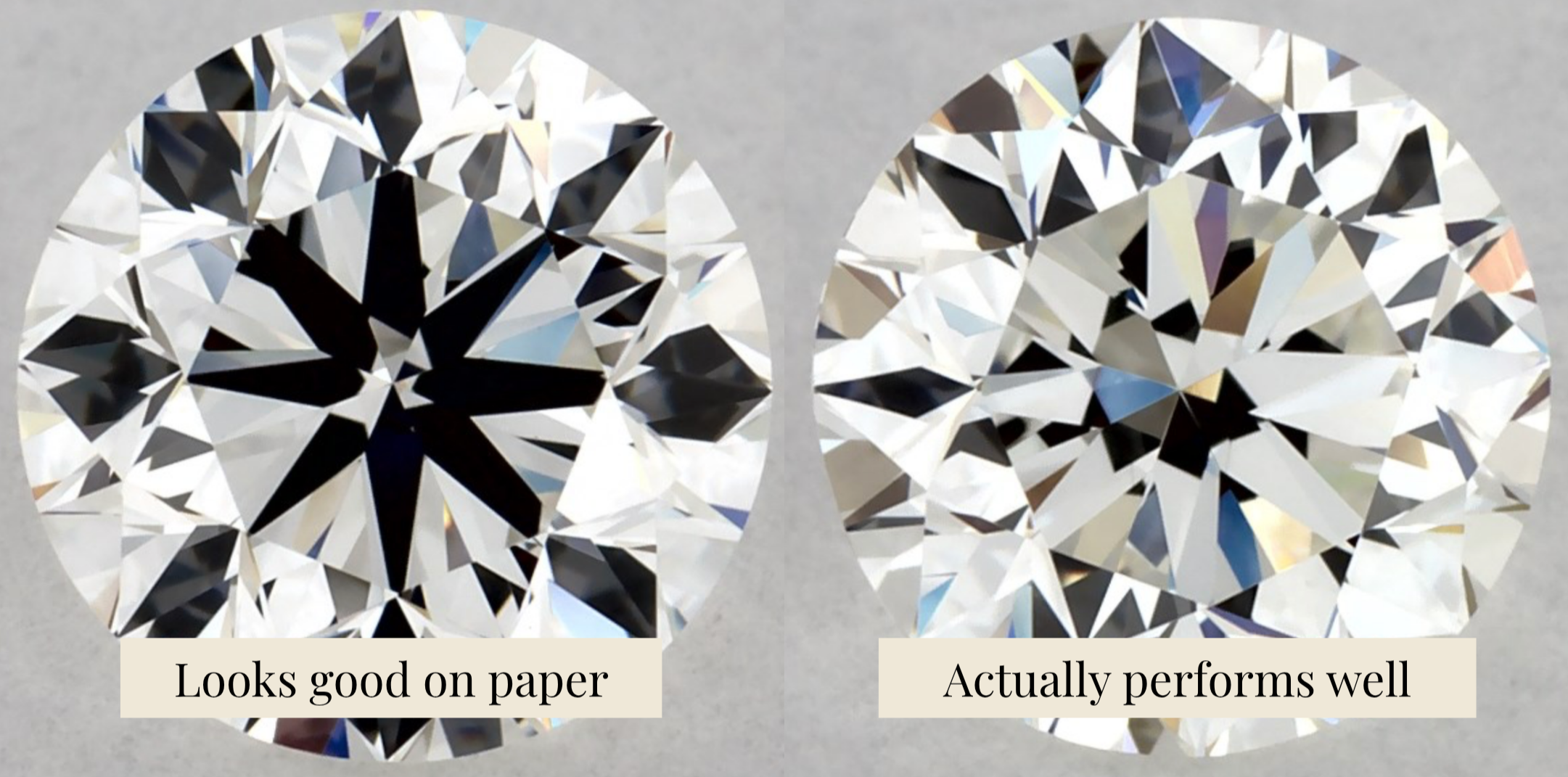
If a diamond doesn’t sparkle well in ideal lighting, it won’t perform well in real life either.
What About Hearts and Arrows?
Hearts and arrows refers to a specific symmetry pattern visible under special viewers, and it’s often marketed as a marker of exceptional cut quality.
I look at general facet alignment and symmetry, but I don’t put significant weight on hearts and arrows patterning specifically.
What matters is how the diamond actually performs visually.
If the facets are well aligned and the sparkle is strong, the diamond is doing its job. With or without a perfect hearts and arrows pattern.
What does a good performing round diamond look like?
A good performing round diamond looks bright, lively, and full of contrast.
Under light, it should throw strong white and coloured flashes. Under diffused or everyday lighting, it should still show depth and sparkle rather than appearing flat or glassy.
If it looks dull in optimal conditions, it will disappoint in real life.
2. Clarity. But Not the Way Most People Think About It
Clarity is one of the most misunderstood parts of choosing a round diamond.
And it goes wrong in two very different directions.
The Inclusions That Actually Matter
Not all inclusions are created equal.
When I’m reviewing a round diamond’s clarity, I’m not just asking what grade it received.
I’m asking:
Are there any visible inclusions?
Are any of them black?
Are any of them surface-breaking?
Surface-breaking inclusions (ones that reach the outer surface of the diamond) aren’t just a visual concern.
They can affect durability.
A chip, crack, or cavity that breaks the surface creates a structural vulnerability.
And in a ring that’s worn every day, that matters.
Black inclusions are a different issue.
Even a small dark inclusion can draw the eye immediately in a round diamond, especially given how much light the shape moves.
Contrast that highlights a black spot is not the kind of contrast you want.
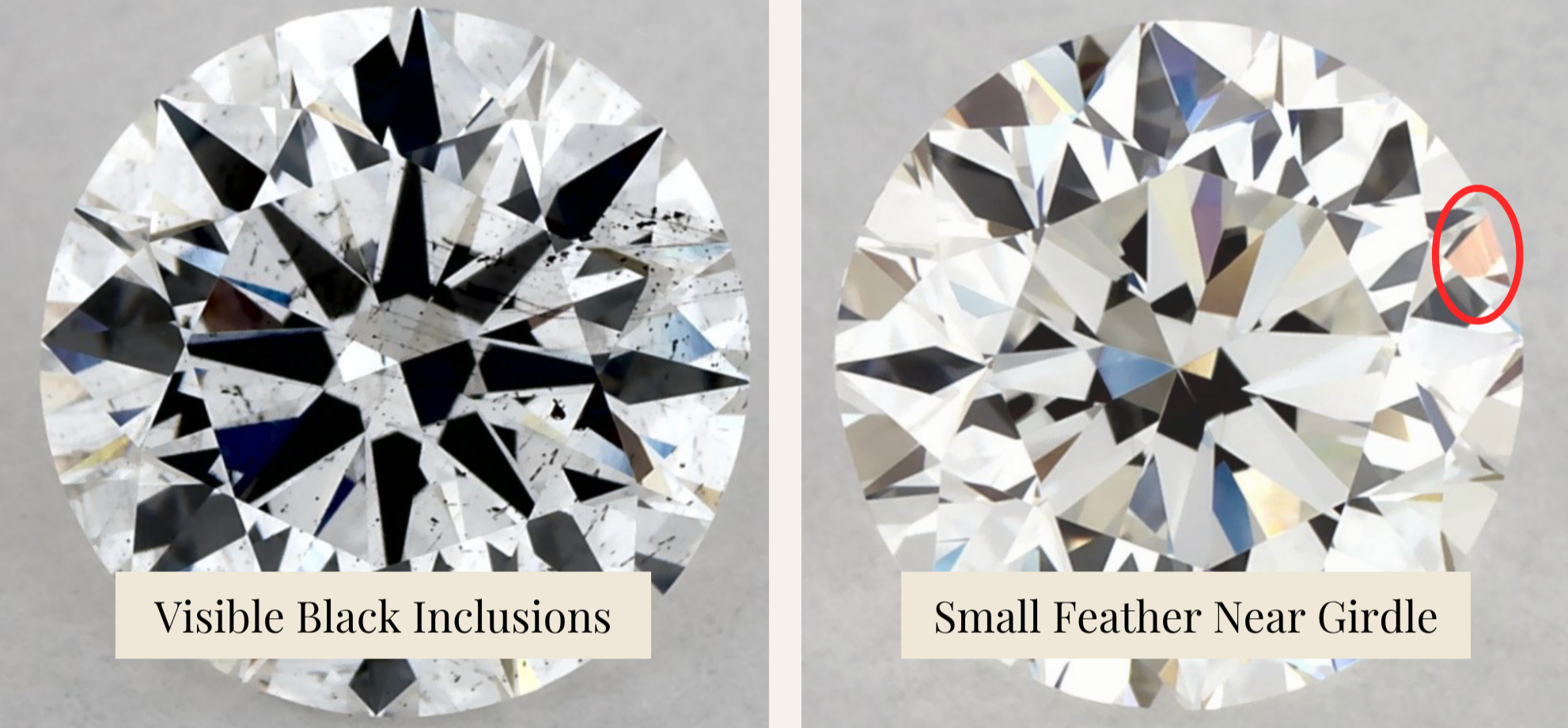
Inclusion type and placement matter more than the grade alone. Black inclusions under the table are far more noticeable than a feather near the edge.
The Diminishing Returns Problem
This is the other side of clarity that most buyers don’t hear about.
There’s a real point of diminishing returns when it comes to clarity grades in round diamonds.
Moving from VS2 to VS1 is often reasonable.
Moving from VS1 to VVS2, or from VVS2 to VVS1, or into FL territory?
In most cases, you’re paying a meaningful premium for a difference you will never see.
I’ve reviewed diamonds graded VVS1 and VS2 side by side.
In real life, on a finger, the difference is usually invisible.
But the price difference isn’t.
That money is almost always better spent on cut quality and light performance.
On the things you’ll actually see every day.
What clarity grade should I choose for a round diamond?
For most round diamonds, VS1 or VS2 is the practical sweet spot.
Eye-clean, well priced, and leaving budget for the things that actually affect how the diamond looks.
The most important questions aren’t about the grade. They’re about whether any inclusions are visible, black, or surface-breaking.
3. Fluorescence. The One People Keep Getting Wrong
This is the topic I find myself correcting most often.
And honestly, even in communities where people think they know a lot about diamonds (Reddit, enthusiast forums, even some industry spaces), there’s still a persistent narrative that fluorescence is fine, maybe even a good thing.
I disagree. Strongly.
What Fluorescence Actually Does
Fluorescence refers to how a diamond reacts to UV light.
Some diamonds have none. Some have faint, medium, strong, or very strong fluorescence. And fluorescence is most commonly blue.
The argument for fluorescence is usually":
“It can make a lower colour grade look whiter, so you can get more value for your money.”
And in ver specific, very controlled circumstances, that can be true.
But here’s what I’ve actually seen:
Diamonds with medium fluorescence that looked grey and hazy in natural light.
Not slightly milky. Noticeably grey.
And more than once, I’ve seen strong blue fluorescence so intense that the diamond visibly glowed in sunlight.
Not a subtle tint.
A glow. Like it was sitting under a blacklight.
That’s not a look most people want in an engagement ring.
And it’s not something that shows up reliably in photos, in controlled lighting, or even always in a 360° video.
It shows up in real life.
What About “Faint” Fluorescence?
Faint fluorescence is genuinely low risk for most stones.
It’s medium, strong, and very strong where I’d advise real caution. Especially if you’re buying without seeing the diamond in person first.
The safest approach is none or faint.
Beyond that, I’d want to evaluate the specific stone carefully before recommending it.
Is fluorescence bad in a diamond?
It depends on the intensity.
Faint fluorescence is generally low risk.
Medium to very strong fluorescence can cause haziness, a grey or milky appearance, or a strong blue glow in natural light.
This doesn’t happen with every stone, but it happens enough that I consistently advise caution. Especially when buying without the ability to see the diamond in natural light first.
What About Proportions?
You’ll find a lot of content online about ideal table percentages, depth ranges, crown angles, and pavilion angles for round diamonds.
And yes, proportions matter.
But the way this gets discussed online often makes it sound more rigid than it actually is.
Proportions for round diamonds work as ranges, not fixed targets.
As long as a diamond falls within those ranges, it’s in a position to perform well.
That doesn’t mean it will though. Performance still needs to be evaluated visually.
But it also means you don’t need to agonize over whether a diamond’s table is 57% versus 58%.
If it falls within a reasonable range and the performance is there when you look at it, you’re in good shape.
Where proportions become a real problem is at the extremes:
stones that are cut too deep, trapping light at the bottom
or too shallow, letting it fall straight through
Those issues are usually visible in performance, which is why I always come back to the same place:
Watch the diamond. Don’t just read the certificate.
Why Round Diamonds Aren’t as Simple as They Seem
The irony of the round brilliant diamond is this:
It’s the most studied, most optimized, most standardized diamond shape in existence.
And yet buyers still end up with disappointing stones all the time.
Because standardization created the false belief that if the grade looks right, the diamond must be right.
A Triple Excellent grade means the lab evaluated cut, polish, and symmetry as excellent.
It doesn’t mean the diamond performs beautifully.
It doesn’t mean the inclusions are in the right place.
It doesn’t mean the fluorescence won’t cause issues.
And it doesn’t mean you won’t spend a significant premium on a clarity grade that makes no visual difference at all.
The certificate is a starting point.
Not the answer.
A Simpler Way to Approach It
Instead of trying to optimize every number, focus on three questions:
Does it perform?
Look for strong sparkle, fire, and contrast under light. Especially in video.Is the clarity actually clean?
No visible, black, or surface-breaking inclusions.What’s the fluorescence?
None or faint. Anything stronger, evaluate carefully.
If a round diamond clears those three things, you’re already ahead of most buyers.
From there, proportions and other specs become refinements, not the foundation.
Want a Second Set of Eyes?
Round diamonds are the most forgiving shape in some ways, and the most deceiving in others.
If you’re looking at a specific stone and want to know whether it actually performs the way it should, I offer a quick diamond review where I’ll go through it and tell you exactly what I see.
And if you want full support from sourcing to final decision, explore Engagement Ring Guidance.
Comparing round diamonds and not sure what actually separates them?
Grab the free guide: 5 things to ask before you buy, so you’re not choosing on grade alone.
Helpful Next Steps
Why Good Diamonds Still Look Bad
Am I Overpaying for a Diamond?
Is This a Good Diamond? How to Actually Tell
And, if you ever want a second set of eyes on a specific diamond, I’m always happy to take a look and point out what I’d be paying attention to.
About the Author
Robyn Bell-Wong is a Calgary-based Independent Jewellery Advisor and Consultant specializing in engagement rings, diamonds, and meaningful fine jewellery purchases.
With over 20 years of experience in service, 5 years at the top of a fine jewellery house, 300+ clients guided, and a GIA Applied Jewelry Professional designation, she provides private, buyer-side guidance to clients making high value jewellery decisions across Canada and the U.S.
Unlike traditional jewellery retail environments, Robyn does not sell jewellery or work on commission. Her role is to act solely in her client’s best interest. Offering clear, objective guidance on quality, value, and design so clients can make confident, well-informed decisions.
Through Refined by Robyn, she supports clients with engagement ring guidance, independent ring reviews, and private jewellery consulting for meaningful purchases.
Her work focuses on helping clients avoid costly mistakes, navigate overwhelming options, and choose jewellery that truly reflects their intention, style, and budget.
Request a private consultation
Follow on Instagram @refined.by.robyn