

If you’ve ever asked a jeweller to source diamonds for you, you probably weren’t shown every option on the market. You were shown a shortlist. Five diamonds, maybe fewer, laid out with a clear opinion attached:
“Here are the top few, and why.”
That part is genuinely helpful. Nobody can meaningfully compare hundreds of diamonds at once, and a good shortlist is one of the more useful things a jeweller can actually do for you.
But there’s a version of this I see constantly that’s worth knowing about, and it’s a little different from the classic “three tier pricing” trick people usually imagine.
How a Legitimate Diamond Shortlist Actually Gets Built
This part isn’t the problem. And I want to be crystal clear about that.
When sourcing diamonds from the broader market, a common approach is to present no more than four or five options. This is so the buyer isn’t drowning in decision fatigue.
The options are typically laid out in order of carat weight, smallest to largest, with a few flagged as the top picks and a clear “why” attached to each one.
This is not manipulation.
It’s a genuinely useful way to narrow an overwhelming market down to something a person can actually evaluate. I did this constantly, and it’s still exactly the kind of thing worth asking for if you’re comparing diamonds today.
Where It Gets More Complicated
Here’s the issue in the presentation.
Sometimes the shortlist isn’t only pulling options from the open market.
Sometimes it includes a diamond already sitting in the store’s inventory, and that one usually gets framed as the standout.
When I had something in stock that we wanted to move, and a client wanted me to run a search anyway, I’d find genuinely excellent options from outside vendors to include.
Real options, real comparisons.
But the in stock diamond would be presented as the deal of the group. The one that outperformed the rest for the price.
And most of the time, that’s the one the client chose.
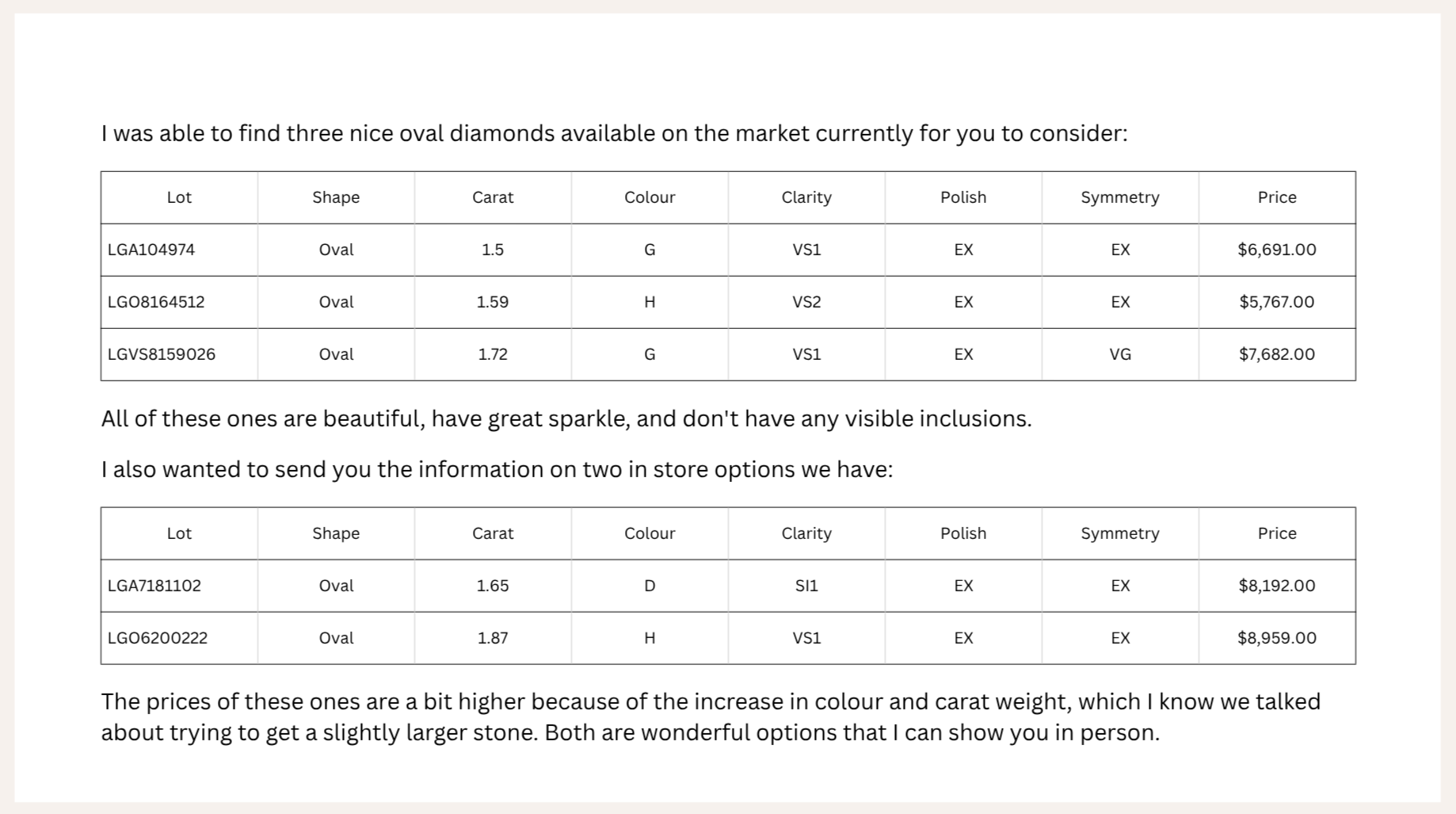
A real example of how in store diamond options are presented to be a better option.
I want to be specific about why this happened, because it’s not that the in stock diamond was worse or better. But it carried a different incentive than the sourced options did.
A diamond already sitting in inventory has its own carrying cost, and moving it serves the business in a way that sourcing something new from an outside vendor doesn’t.
That incentive doesn’t make the in stock diamond bad. It just means the “why” behind that particular recommendation wasn’t only about which diamond was best for the client. It was also doing something for the store.
Why do jewellers recommend the diamond they already have in stock?
Inventory a store already owns carries a holding cost, and selling it serves the business in a way that sourcing a new stone from an outside vendor doesn’t.
That’s not a reason to automatically distrust an in stock recommendation, but it’s a different incentive than a purely client first comparison.
This Isn’t the Same As the Classic Three Tier Trick
This is worth separating from the pricing psychology you might already know.
Small - Medium - Large (sizes, like coffee)
Or
Good - Better - Best (pricing tiers)
That version works by structuring the presentation itself to make one option feel obviously right. Regardless of what’s actually in front of you.
What I’m describing is subtler.
The comparisons are real.
The other diamonds genuinely exist.
They’re genuinely strong options.
The steering toward a decision is where one gets framed as the standout option. Not in the structure of the choices themselves.
Is a curated diamond shortlist a bad thing?
Not at all. A well built shortlist is one of the more useful things a jeweller can do, since comparing an entire market by yourself isn’t realistic.
The thing worth paying attention to isn’t whether you’re shown a shortlist. It’s understanding why each option on it is being recommended, and whether that reasoning is about the diamond, or about what’s easiest to sell.
What To Actually Ask the Salesperson
If you’re being shown a shortlist, whether it’s diamonds or rings, these questions cut through most of this:
Is this diamond from your own inventory, or sourced specifically for me?
What specifically makes this one the top pick, beyond “it’s a great deal”?
If I didn’t ask you to run a search, would this still be the diamond you’d recommend?
None of these questions assume bad faith.
They just ask for the reasoning to be made explicit instead of implied.
This is usually all it takes to see whether a recommendation is about your priorities or what’s already sitting in the case.
What About Ring Settings?
Ring setting options are different from diamond options.
They tend to work less like a shortlist and more like a budget and wishlist exercise, matching what a client wants stylistically against what actually fits their budget.
That’s not universal across every retailer, but it’s a different dynamic than diamond sourcing.
What This Means For You
A curated set of options isn’t something to be suspicious of.
It’s actually one of the more useful parts of working with someone who knows the market.
But, it’s important to understand that “the best deal on the list” and “the best diamond for you” aren’t always the same thing. And the reasoning behind a recommendation is worth asking for directly instead of taking it as a given.
Want a Shortlist Built Around You, Not Inventory?
If you’re comparing diamonds and want a shortlist built entirely around your priorities and budget, with no inventory to move and no incentive tied to which one you choose, that’s exactly what a private diamond search through Engagement Ring Guidance will do.
If you’ve already got a shortlist from somewhere else and want a second opinion on it to help you choose the right diamond, I offer a quick diamond review where I’ll telly you exactly what you’re looking at.
Not sure if you’re seeing the best options, or just what’s in stock?
Grab the free guide: 5 things to ask before you buy, so you know what’s actually worth asking before you pick from the list you’re handed.
Helpful Next Steps
Am I Overpaying for a Diamond?
Retail Price vs The Right Price
Buying an Engagement Ring Without Independent Advice
About the Author
Robyn Bell-Wong is a Calgary-based Independent Jewellery Advisor and Consultant specializing in engagement rings, diamonds, and meaningful fine jewellery purchases.
With over 20 years of experience in service, 5 years at the top of a fine jewellery house, 300+ clients guided, and a GIA Applied Jewelry Professional designation, she provides private, buyer-side guidance to clients making high value jewellery decisions across Canada and the U.S.
Unlike traditional jewellery retail environments, Robyn does not sell jewellery or work on commission. Her role is to act solely in her client’s best interest. Offering clear, objective guidance on quality, value, and design so clients can make confident, well-informed decisions.
Through Refined by Robyn, she supports clients with engagement ring guidance, independent ring reviews, and private jewellery consulting for meaningful purchases.
Her work focuses on helping clients avoid costly mistakes, navigate overwhelming options, and choose jewellery that truly reflects their intention, style, and budget.
Request a private consultation
Follow on Instagram @refined.by.robyn