
Retail Price vs. The Right Price: What Comparison Shopping Actually Saves You
Here’s a conversation I have constantly.
A client sends me a diamond he’s considering buying from a retailer.
Beautiful presentation.
Great lighting.
A price that feels justified because everything about the experience feels luxury.
Then I go looking.
I find diamonds with the same specs, sometimes the exact same stone, available through a different vendor.
Or the same diamond, at the same retailer, but I know the price is actually negotiable if you know how to ask.
With some work, the price moves.
Not slightly. Usually thousands of dollars.
I’m not writing this to talk about cutting anyone out or finding some secret backdoor to a diamond cutter. This is about something more ordinary:
Most buyers only ever see one price, from one source, and have no way to know whether it’s the right price or not.
Why is the same diamond priced differently depending on where I look?
Retailers price diamonds based on their own overhead, positioning, and margins. Not a fixed industry number.
The same or comparable diamond can be available through multiple legitimate channels at different prices, and many retail prices have more room to negotiate than you realize.
Without comparing across sources or knowing what’s actually negotiable, most people just pay the first number they see.
Retail Pricing Isn’t Always Fixed.
Most buyers walk in to a store, are given a price, and assume that’s it.
When I’m given a price, I use it as a starting point.
A diamond’s price at retail reflects:
The diamond itself
That specific retailer’s overhead and business model
Their margin for that particular stone or that day’s promotion
How much room they’ve built in to the price for negotiation
That last one is the part that a lot of people don’t know about. Not because retailers are being dishonest, but because negotiation a diamond isn’t something most people have ever had a reason to learn.
The first number isn’t always the real number.
Can you actually negotiate a diamond’s price?
Often yes.
How much room there is depends on the retailer, the specific stone, and how it’s being positioned. Knowing what’s genuinely negotiable (and what isn’t) is where market knowledge makes the difference. Not just asking for a discount and hoping.
A Real Example
Details adjusted for privacy.
A client came to me with a 1.50ct round brilliant cut diamond he fell in love with.
Available from a well known retailer.
Presented beautifully.
Confident sales experience.
Priced where he was willing to pay.
The diamond itself was solid. There wasn’t anything wrong with the specs.
But I knew that diamond, and ones like it, had more room in the price than he was being shown.
And when I compared it against similar ones available on the market, there was a meaningfully better option for less.
We went back to the retailer with that information.
He didn’t change stores.
He didn’t downgrade anything.
But he paid thousands less for the same diamond.
Why?
Because he had someone in the conversation that actually knew what that diamond was worth.
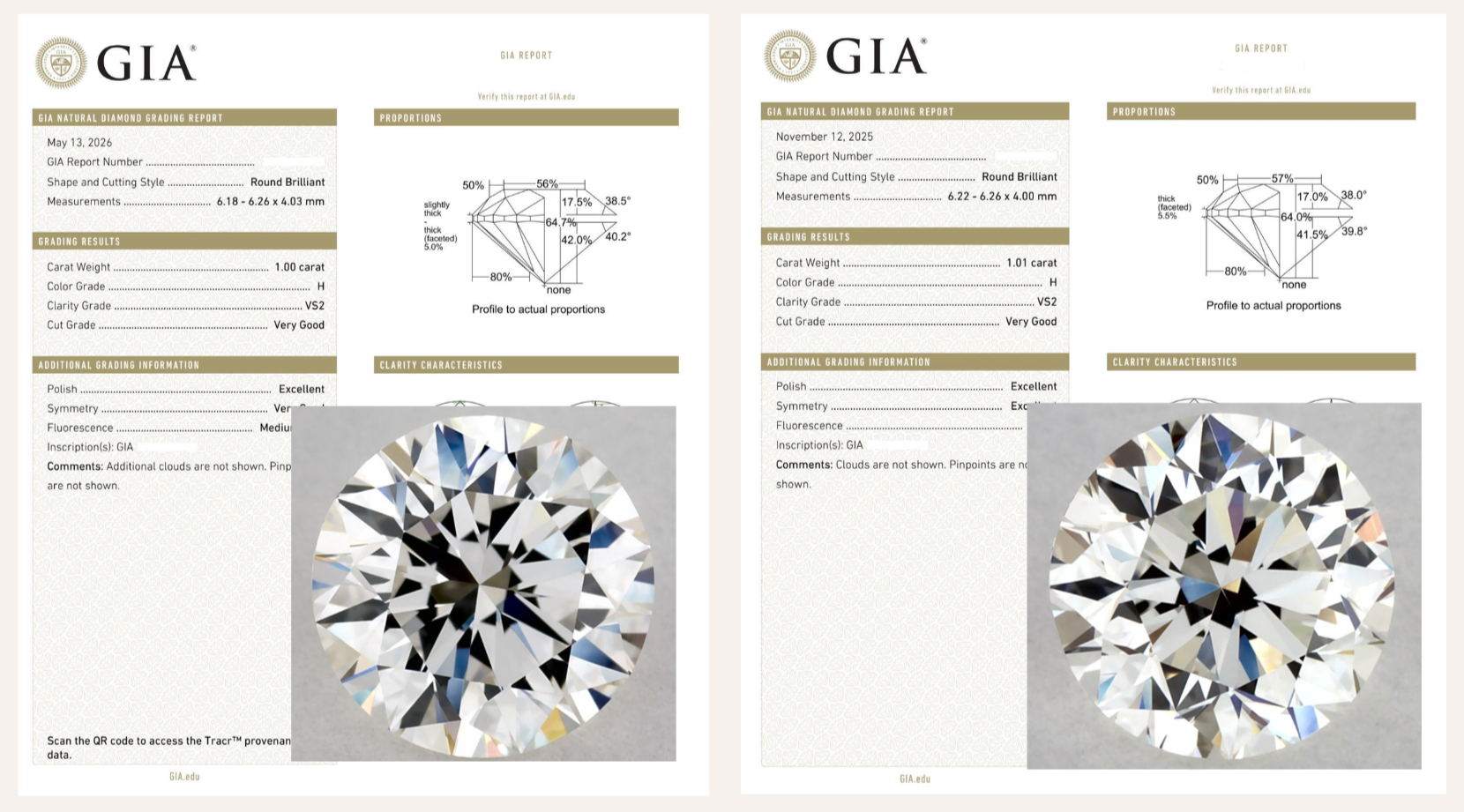
Same diamond. Same performance. Different starting point.
Is comparing diamond prices the same as buying somewhere sketchy or the “grey market”?
No. This is about comparing legitimate retailers and vendors against each other, and knowing where a price has room. Not going around the industry entirely.
The diamond, the paperwork, and the retailer are all still exactly what they appear to be. What changes is whether you’re the only person in the room who doesn’t know what it’s actually worth.
Why Most Buyers Don’t Get This Advantage
This isn’t a conspiracy. It’s just structural.
The person selling you the diamond has no reason to tell you the price has room, or that a comparable stone is available somewhere else for less.
That’s not their job.
Their job is to sell you what’s in front of you.
And most buyers don’t have a reference point. You’ve likely never bought a diamond before.
You don’t know what a fair price looks like, what’s negotiable, or how to compare one retailer’s positioning against another’s.
That’s not something you’re supposed to already know.
It’s just the gap that exists when you’re doing this for the first (and hopefully only) time.
(Related: Buying an Engagement Ring Without Independent Advice)
What does an independent engagement ring advisor do differently than a salesperson?
A salesperson represents the retailer. An independent engagement ring advisor represents you.
That means comparing across retailers instead of one, knowing where a price is negotiable, and evaluating whether the diamond actually performs the way the price suggests, all without any commission tied to where you buy it.
Why This Isn’t as Simple as “Just Negotiate Harder”
I want to be honest about something here, because this isn’t a simple hack.
Negotiating without understanding the diamond itself is just as risky as overpaying.
You can push a price down and still end up with a diamond that underperforms visually. I talk about this exact problem constantly.
A lower price only means something if the diamond behind it actually holds up.
The part that matters more than the final number:
Making sure the price and performance actually match. Not just getting a discount for the sake of one.
What’s the risk of focusing only on getting the lowest price for a diamond?
The risk is optimizing for a number instead of the diamond.
A diamond can be aggressively discounted and still be a poor performer. In fact, that might be why it’s discounted so much.
Price and evaluation of a diamond have to happen together, not one instead of the other.
What This Actually Means for Your Budget
This is where the real opportunity is, and it’s not just “spend less.”
For a lot of clients, the gap between the first price they were shown and the right price doesn’t just mean saving money.
It means:
Getting a noticeably better performing diamond for the same budget
Or getting the same diamond for meaningfully less
Or reallocating that difference toward a better cut, a stronger ring setting, or both
The number itself isn’t the point. What you do with the gap is.
Should I use the savings to upgrade the ring, or just save the money?
There’s not a universal rule, and it depends entirely on your priorities.
Some clients use the difference to move up in size or cut quality. Others prefer to keep the ring exactly where they wanted it and simply spend less overall.
What matters is making that decision on purpose, instead of by accident, or not knowing there was a decision to make at all.
Before You Commit to a Retail Price, Get a Second Opinion
If you’ve found a diamond you love at a retailer, that doesn’t mean the first number you’re given is the final number.
Before you commit, it’s worth understanding whether that price has room, and whether a comparable diamond (at the same quality, evaluated properly) is available somewhere else for less.
That’s exactly what I help clients through with a Ring Review: a clear, unbiased assessment of what you’re looking at, what it’s actually worth, and whether the price in front of you reflects that.
If you’re earlier in the process or want full support from comparison shopping through the final decision, Engagement Ring Guidance is 1:1 expert guidance until you find the right engagement ring.
Found a diamond you love at a specific price?
Grab the free guide: 5 things to ask before you buy, so you know what to ask before assuming that number is the real number.
About the Author
Robyn Bell-Wong is a Calgary-based Independent Jewellery Advisor and Consultant specializing in engagement rings, diamonds, and meaningful fine jewellery purchases.
With over 20 years of experience in service, 5 years at the top of a fine jewellery house, 300+ clients guided, and a GIA Applied Jewelry Professional designation, she provides private, buyer-side guidance to clients making high value jewellery decisions across Canada and the U.S.
Unlike traditional jewellery retail environments, Robyn does not sell jewellery or work on commission. Her role is to act solely in her client’s best interest. Offering clear, objective guidance on quality, value, and design so clients can make confident, well-informed decisions.
Through Refined by Robyn, she supports clients with engagement ring guidance, independent ring reviews, and private jewellery consulting for meaningful purchases.
Her work focuses on helping clients avoid costly mistakes, navigate overwhelming options, and choose jewellery that truly reflects their intention, style, and budget.
Request a private consultation
Follow on Instagram @refined.by.robyn