
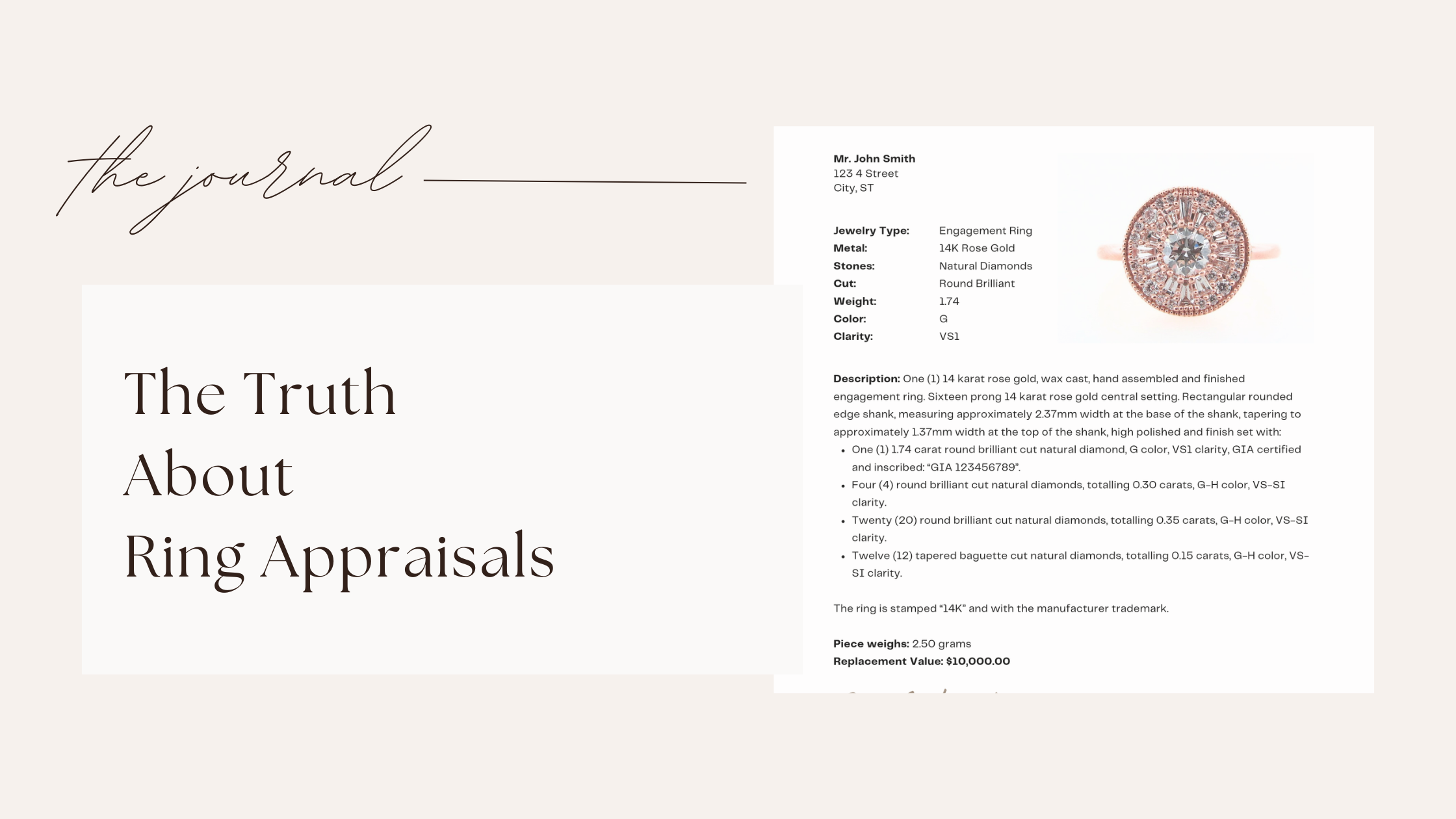
If anyone’s ever shown you an appraisal to prove you’re getting a good deal on a ring, I need you to actually read this before it happens again.
An appraisal looks official. It breaks down every component of the ring, weight, measurements, diamond details, materials, and lands on a number. And that number is almost always higher than the price tag. Sometimes a lot higher.
It feels like proof. I’m getting something worth more than what I’m paying. I got a deal.
Here’s the problem. I used to write these.
How The Appraisal Price Actually Gets Made
A lot of in store ring appraisals aren’t done by a third party appraiser. They’re done by the store.
The formula is simple:
Take the weight, the measurements, the diamond details, the materials, apply a markup to the retail price, sometimes 1.5 to 2 times, and print that as the “appraised value.”
I know exactly how this works because I did it. I was told to explain the gap as accounting for inflation, for insurance purposes.
That explanation isn’t entirely made up. Insurance replacement value is a real concept. But that’s not what was actually happening with the number I was writing, and it’s usually not what’s happening with the one you’re looking at either.
Why is a ring appraisal higher than the price I paid?
Sometimes it’s a legitimate replacement value calculation. But a lot of in store appraisals are built from a straightforward formula, the store’s own retail price with a markup applied on top (sometimes as much as double), and printed as the appraised value. The gap you’re seeing isn’t automatically a sign of anything except that formula.
Engagement Ring Insurance
This is what most people never find out until it’s too late to matter.
Most insurance providers require an updated appraisal every 5 to 10 years. And some won’t honour the full replacement cost of a lost or stolen ring when the appraisal on file is obviously inflated, because it doesn’t reflect what it would actually cost to replace the piece.
So the number that made you feel good on the day you bought the ring can end up working against you later, at exactly the moment you need it to hold up.
Can an inflated appraisal cause a problem with an insurance claim?
Yes. If an insurer determines the appraised value doesn’t reflect a realistic replacement cost, they may not honour the full amount on a claim. An appraisal that looks generous on paper isn’t automatically a benefit. It can actually become a liability at the moment you need it most.
“It Was Appraised at $10,000, But I Only Paid $7,500”
I’ve sat across from so many people who said a version of this exact sentence, convinced it meant they’d gotten a great deal.
Every time, I had to explain what an appraisal actually is:
Mostly a document for insurance purposes. Not an independent valuation of the ring. Not a certificate of quality. And when it’s done in-house, not unbiased.
It’s a formula, run by the store, printed on the store’s letterhead. Sometimes it exists specifically to make the price feel justified, whether or not that’s the stated intention behind it.
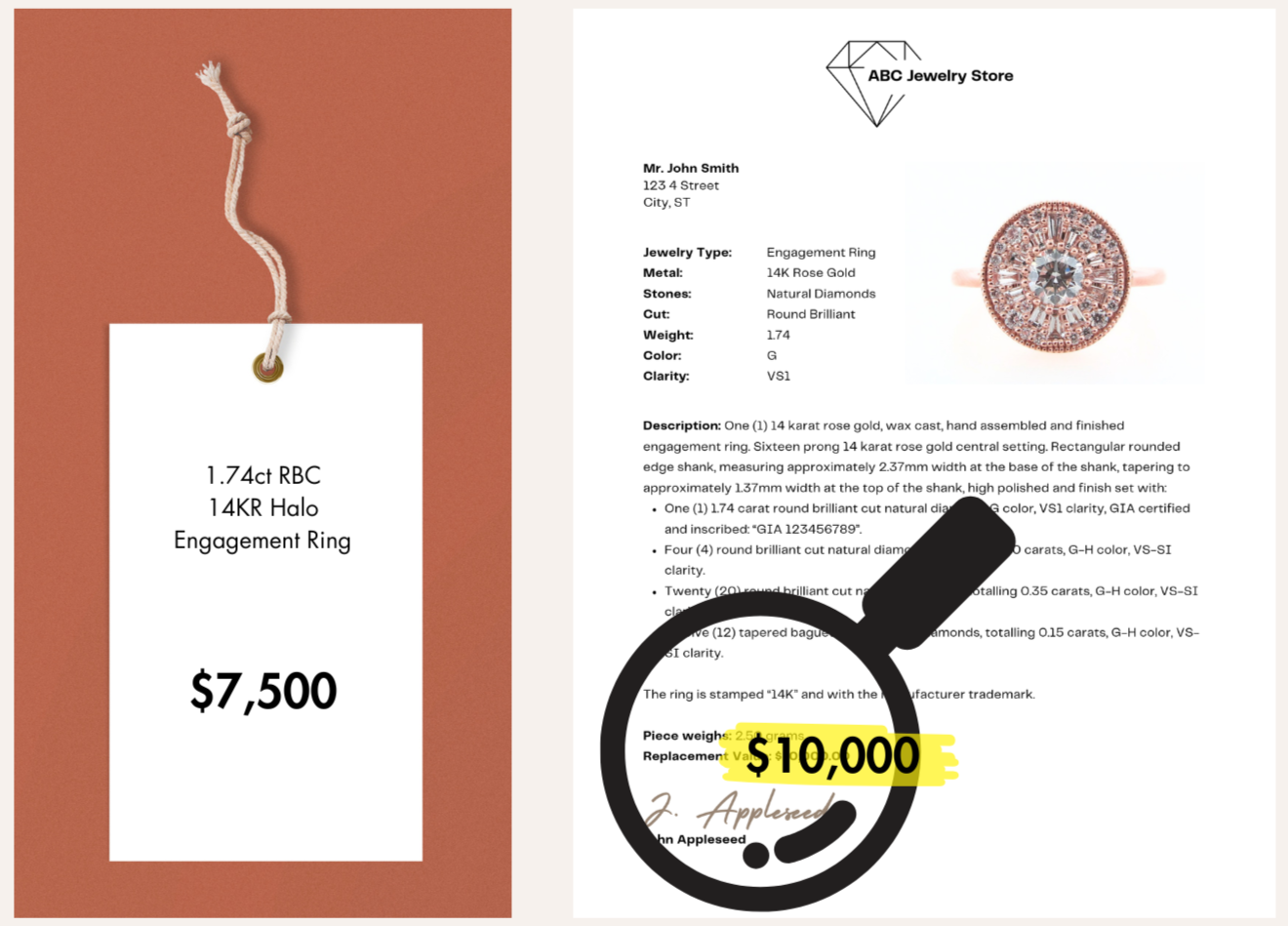
Same ring. One price reflects what you paid. The other price reflects a formula.
Third Party Appraisals Aren’t Automatically Clean
It’s worth being upfront about this part too, because it’s not as simple as “avoid the in store one and you’re safe.”
If a ring is appraised by an unbiased third party, there’s usually still some markup built into that number. It’s typically less inflated than an in store appraisal, but it’s rarely a pure, no markup figure either.
An appraisal, even an independent one, is still one person answering the question “what would this cost to replace at retail,” not “what is this actually worth on the open market.”
Is a third party ring appraisal more accurate than an in store one?
Generally yes, it’s a more independent number than one written by the retailer that sold you the ring. But it’s still typically an educated opinion on a replacement value figure with some markup built in. It’s not a resale or wholesale value, so it isn’t a perfectly neutral number either.
The One Question That Cuts Through Everything
If you’re ever shown an appraisal as a reason to buy a ring, or as proof you got a good deal, ask one question:
Who did this appraisal?
If the answer is the store you’re standing in, treat it as a sales tool. Not as proof of anything.
That’s not an accusation that the store is lying to you. The number can be technically consistent with their own formula and still not be telling you what you think it’s telling you. Those are two different things, and the second one is the one that actually matters when you’re deciding whether you got a good price.
What You Should Actually Do
Get your ring appraised. Insure it properly. That part matters and isn’t in question.
What needs to change is what you use that number to answer.
It’s not a scorecard on your purchase decision.
A big gap between price and appraisal isn’t proof you got a deal, it was never designed to be.
If you want to know whether you actually paid a fair price, or whether the diamond performs the way the price suggests it should, that’s a completely different question, one an in-house appraisal was never built to answer.
Want to Know What You’re Actually Looking At?
If you’ve already found a diamond or ring and want to understand what you’re actually looking at, separate from any number on an appraisal, before you buy, I offer a quick diamond review where I go through it and tell you exactly what you’re looking at.
If you’re earlier in the process and want 1:1 help navigating pricing, sourcing, and evaluation before you buy, explore Engagement Ring Guidance.
About to use an appraisal amount to justify a purchase?
Grab the free guide: 5 things to ask before you buy, so a formula on a piece of paper doesn’t stand in for an actual answer.
Helpful Next Steps
Retail Price vs The Right Price: What Comparison Shopping Actually Saves You
Am I Overpaying for a Diamond?
Buying an Engagement Ring Without Independent Advice
About the Author
Robyn Bell-Wong is a Calgary-based Independent Jewellery Advisor and Consultant specializing in engagement rings, diamonds, and meaningful fine jewellery purchases.
With over 20 years of experience in service, 5 years at the top of a fine jewellery house, 300+ clients guided, and a GIA Applied Jewelry Professional designation, she provides private, buyer-side guidance to clients making high value jewellery decisions across Canada and the U.S.
Unlike traditional jewellery retail environments, Robyn does not sell jewellery or work on commission. Her role is to act solely in her client’s best interest. Offering clear, objective guidance on quality, value, and design so clients can make confident, well-informed decisions.
Through Refined by Robyn, she supports clients with engagement ring guidance, independent ring reviews, and private jewellery consulting for meaningful purchases.
Her work focuses on helping clients avoid costly mistakes, navigate overwhelming options, and choose jewellery that truly reflects their intention, style, and budget.
Request a private consultation
Follow on Instagram @refined.by.robyn