
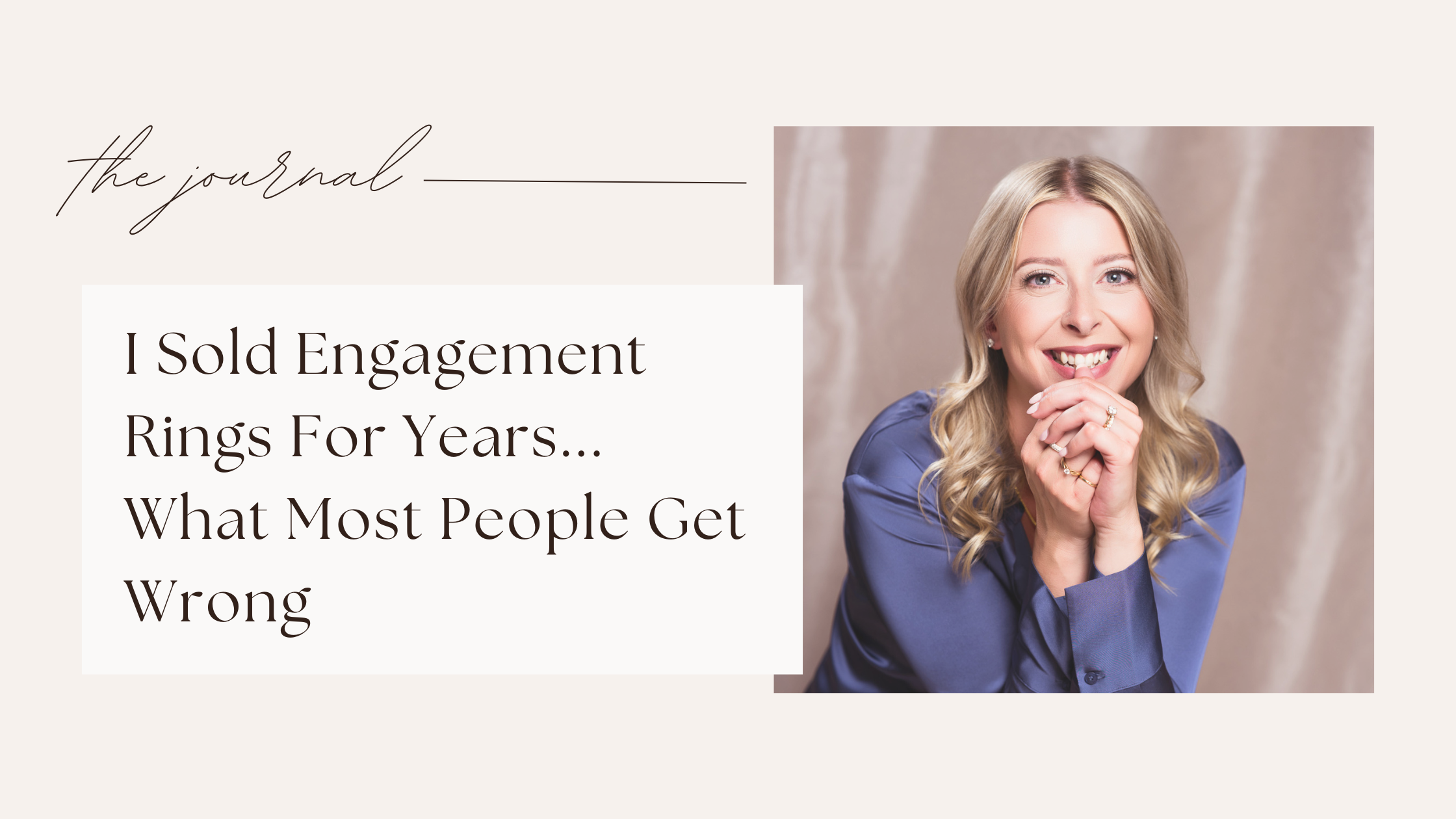
I used to be very good at selling engagement rings.
When I worked at a luxury retailer, my close rate was about 90%. That means nine out of ten people who sat down with me left with a purchase.
And I’m not saying that to brag. I’m saying it because I want you to understand something important.
That 90% close rate wasn’t just about being helpful. It was about a system.
A very deliberate, very well designed system.
And most engagement ring buyers don’t know it exists.
How I Was Trained to Sell
Before I ever spoke to a client, I had to learn the process. Train to be a salesperson.
I had to learn the basics of jewellery anatomy.
The product knowledge.
The terminology.
And most importantly, I had to learn how to handle objections.
Because in a luxury retail environment, objections aren’t surprises.
They’re expected. Studied. Prepared for.
Any objection a potential buyer might have:
Price concerns
Wanting to think about it
Considering buying online
They all had a practiced and standardized response.
This training wasn’t unique to where I worked.
It’s an industry standard.
And it’s worth understanding, because it changes how you can approach every interaction you have in a jewellery store.
The Diamond Lesson
Almost every serious engagement ring consultation at a luxury retailer starts the same way.
It’s called a diamond lesson.
And on the surface, it genuinely looks like education.
You have a private conversation with a salesperson who walks you through the 4 Cs (cut, colour, clarity, carat).
They explain the differences.
They show examples.
They make it feel thorough and trustworthy.
Where I worked, they even added a 5th “C”: Certification.
And the information itself wasn’t wrong.
But the way it was presented? That was strategic.
The diamond lesson was designed to be overwhelming.
Not because diamonds are impossible to understand. But because a buyer who feels overwhelmed is a buyer who stops trusting their own judgement.
Layered into that lesson was a subtle but deliberate message:
There are dangers hiding in diamonds that you’d never catch on your own.
Inclusions that could cause a diamond to fracture.
Quality differences that aren’t visible without expertise.
Risks you’d be taking if you tried to navigate this alone.
Again, not entirely untrue.
But the goal wasn’t purely to inform.
The goal was to make buying alone feel dangerous. And to make buying from us feel safe.
Why Was I Taught To Do A Diamond Lesson?
The diamond lesson served two purposes:
It built genuine product knowledge in the buyer, which helped them feel more confident.
And more importantly in a sales context, it created controlled overwhelm.
A buyer who feels like the category is too complex to navigate alone is far more likely to trust the person in front of them.
And far less likely to leave and keep looking.
The Markup Reality
Here’s something really important to know:
The markup on a ring setting at a luxury retailer is significantly higher than the markup on a certified diamond.
This means a salesperson has a financial incentive to make sure you buy both from them.
Not just the ring. The diamond too.
And the diamond lesson?
With its emphasis on the risks of buying diamonds elsewhere, the dangers of uncertified stones, the liability of setting a diamond they don’t source, serves that goal perfectly.
To be fair, some of those warnings are legitimate.
Uncertified diamonds are genuinely risky. You have no way to verify the quality of what you’re buying.
And there are real considerations around sourcing a diamond from outside a store and asking them to set it (liability, compatibility, workmanship questions).
But those legitimate concerns were woven into a presentation designed to keep the entire sale in one place.
And most people couldn’t tell where the genuine advice ended and the sales strategy began.
Because it was never presented as a sales strategy.
It was presented as education.
What Happens When You’re Just Browsing
Not every engagement ring consultation followed the full diamond lesson process.
Sometimes people came in already knowing what they wanted… or close to it.
In those cases, it was much more standard retail:
Show them what’s available.
Find what checks their boxes.
If it’s not in stock, order it in.
The underlying goal was the same though.
Do whatever’s necessary not to lose the sale.
Don’t lose them to the internet.
Don’t lose them to the competition.
Don’t lose them to “I need to think about it.”
Every objection had a response. Every hesitation had a technique.
And most of it was delivered with genuine warmth and enthusiasm. Because the best salespeople actually do care about their clients.
And honestly, that’s what makes it so hard to see from the outside.
What Most Buyers Get Wrong As A Result
After years on that side of the table, and now years on the buyer’s side, here’s what I see most often.
People Confuse A Good Sales Experience With Good Advice
A skilled salesperson makes you feel heard, understood, and guided.
They make you feel comfortable.
That experience is real, but it’s not the same as advice that’s focused entirely on your best interests.
There's a difference between someone who’s really good at their job in sales, and someone whose only goal is your outcome.
Most buyers never feel that difference because the experience is designed not to feel like sales.
They Mistake The Diamond Lesson For Complete Education
The 4Cs of a diamond are a framework, not a full picture.
And the way they’re typically taught in a sales context is designed to create reliance, not independence.
Understanding cut, colour, clarity, and carat matters.
But knowing how a diamond actually performs visually (what to look for in a video, how light return works, what makes one “excellent” grade look completely different from another), that’s the part that rarely gets covered in a diamond lesson.
Because that knowledge helps you evaluate diamonds anywhere.
And that’s not what a retailer needs you to be able to do.
They Don’t Realize How Much The Setting Markup Affects The Conversation
When you understand that setting margins are significantly higher than diamond margins, a lot of consultation dynamics start making more sense.
Why the conversation steers toward full engagement ring packages.
Why sourcing your own diamond and bringing it in is subtly discouraged.
Why “we can get you exactly what you want” is always the answer, even when what you want might be better sources elsewhere.
None of this is malicious… It’s just business.
But it’s worth understanding so you can factor it in.
They Think Hesitation Is A Problem To Solve
One of the most important psychological things I was trained to handle was hesitation.
“I want to think about it.”
“I need to talk to my partner.”
“I’m going to look around a bit more.”
Every one of those responses had a practiced reply designed to keep the conversation moving toward a decision.
And most of the time, it worked.
But hesitation usually exists for a reason.
If something doesn’t feel right, or you’re not sure, or you want more time, that’s not a weakness.
That’s good judgement.
The pressure to decide in the moment is a sales tactic.
Why I’m Telling You This
I want to be clear. I don’t think jewellery retailers are villains.
Most of the people I worked with genuinely cared about their clients.
The industry has real expertise, real value, and plenty of people who do their jobs with integrity.
But the structure of how engagement rings are sold (the training, the techniques, the incentives) is built around closing sales.
Not around making sure you have someone fully in your corner.
The difference can be subtle when you’re inside the experience, but it becomes obvious when you step outside of it.
That’s why I built my business the way I did.
I don’t compete with jewellers. In fact, I’m quite close to a lot of them.
Instead, I wanted to be the thing the industry doesn’t naturally provide:
Someone who sits on your side of the table.
Whose only measure of success is whether you feel genuinely confident in your decision.
Not whether you said yes before you left.
What This Means For You
If you’re currently in the process of buying an engagement ring, none of this means don’t trust every jeweller you speak to.
It means you should go in as an informed shopper.
Know that the diamond lesson is partly education and partly sales psychology.
Know that hesitation is allowed and healthy.
Know that a great sales experience and truly independent advice are two different things.
And know that having someone on your side, before you walk into any store or click any buy button, changes the entire dynamic.
What do most people get wrong when buying an engagement ring?
Most people don’t realize that the guidance they receive inside a jewellery store, however genuine it feels, is shaped by sales incentives, inventory priorities, and closing techniques.
That doesn’t make it dishonest, but it does make it different from advice that’s focused entirely on your outcome.
The biggest mistake is assuming those two things are the same.
You Deserve Someone On Your Side
If you’re navigating this process and want guidance that isn’t attached to any sale, any inventory, or any commission, that’s exactly what Engagement Ring Guidance is built for.
And if you’re already looking at a specific diamond or ring and want an honest second opinion before you commit, a Ring Review gives you that without the sales environment attached.
Because knowing how the system works is the first step.
Having someone in your corner is the second.
Want to walk in already knowing what they won’t tell you?
Grab the free guide: 5 things to ask before you buy, so you’re not relying on a diamond lesson designed to keep you in the room.
Helpful Next Steps
Buying an Engagement Ring Without Independent Advice Is a Risk
Why Researching Engagement Rings Online Creates More Confusion
Am I Overpaying for a Diamond?
About the Author
Robyn Bell-Wong is a Calgary-based Independent Jewellery Advisor and Consultant specializing in engagement rings, diamonds, and meaningful fine jewellery purchases.
With over 20 years of experience in service, 5 years at the top of a fine jewellery house, 300+ clients guided, and a GIA Applied Jewelry Professional designation, she provides private, buyer-side guidance to clients making high value jewellery decisions across Canada and the U.S.
Unlike traditional jewellery retail environments, Robyn does not sell jewellery or work on commission. Her role is to act solely in her client’s best interest. Offering clear, objective guidance on quality, value, and design so clients can make confident, well-informed decisions.
Through Refined by Robyn, she supports clients with engagement ring guidance, independent ring reviews, and private jewellery consulting for meaningful purchases.
Her work focuses on helping clients avoid costly mistakes, navigate overwhelming options, and choose jewellery that truly reflects their intention, style, and budget.
Request a private consultation
Follow on Instagram @refined.by.robyn